
5 Essential Tips for Buying Modular Planter Walls & Creating a Stunning Green Rooftop
A green roof is a smart investment for commercial buildings because of the environmental, financial, and aesthetic benefits it can deliver. Organizations like Green Roofs for Healthy Cities highlight how green roofs contribute to urban sustainability by improving stormwater management and lowering energy costs.
Whether your client’s goal is to improve stormwater management, reduce energy costs, or soften a city skyline views with greenery, the benefits of rooftop planters keep on coming.
By incorporating modular retaining edging planter walls, landscape architects and contractors can design rooftop spaces that are highly functional and visually appealing.
Keep reading to learn more about these rooftop planter solutions. Plus, our expert team has included five important tips you should know before making a purchase to ensure a successful outcome for your project. Looking to transform your rooftop into a stunning green space? Get a free quote from our team of experts and start your next project today!
What Are Connect Modular Retaining Edging Planters?
Because this planting solution acts more like a retaining wall than a container, the combination of metal edging and planter walls showcases the perimeter of any space and is perfect for a green rooftop project.
These planters can be manufactured using COR-TEN weathering steel or marine-grade powder-coated aluminum to produce a durable, lifelong planting plan, eliminating the need to replace your planting system every few years. According to the American Institute of Steel Construction, weathering steel naturally develops a protective rust layer, making it ideal for outdoor applications.
Consider these elegant bottomless planter walls when you want to:
Create large planting areas and green space
Enhance structure and visual appeal
Minimize maintenance and upkeep
Frame a uniquely shaped space or terrace a landscape with metal walls
Shape a walkway or courtyard with a metal curb
Use metal planter walls to reimagine the blank slate of a rooftop design project
The benefits of the Connect Modular Retaining Edging Planters include flexible configuration, customized solutions that include a bottomless design*, and anchored or unanchored options.
* For narrow areas, consider using Connect Modular Planters with full bottoms. For anything more than 4 feet wide, it is more feasible to use our Connect Modular Bottomless Planters.
5 Tips When Buying a Modular Retaining Edging Planter
1. Modular planter wall parameter options
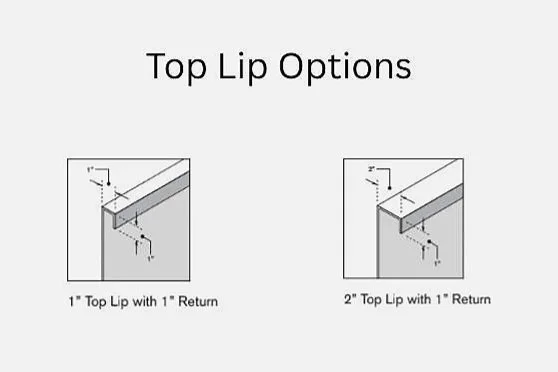
The height, radius of the curve, and top lip design all play a role in the planter’s structural integrity, ease of installation, and overall visual appeal. Taking the time to plan these details ensures a seamless and professional green roof design.
Getting the dimensions right can be a game changer for your modular planter project in terms of both installation, function, and aesthetics.
Here is what we’ve learned after working with clients to create countless successful projects:
Typically:
Heights should stay under 48”.
Individual sections spanning no more than 4 to 6 feet to ensure stability and manageability.
Maintain a curve radius of at least 8” to prevent excessive stress on the materials.
When it comes to the top lip of the planter, we recommend options like a sleek knife edge or a top lip with a return. (See figure below)
If you choose 5052 marine-grade powder-coated aluminum for your design, we recommend using material thickness of 0.188” to 0.250”.
2. How the metal planter walls attach to each other
You’ll want to ensure that your green roof planters are durable, secure, and built to withstand rooftop conditions. A well-designed modular retaining edging planter relies on strong, secure connections between its sections to ensure stability and longevity.
When selecting a planting system, it’s important to understand the attachment methods that will join the metal planter walls. A successful install also depends on how level the space is.
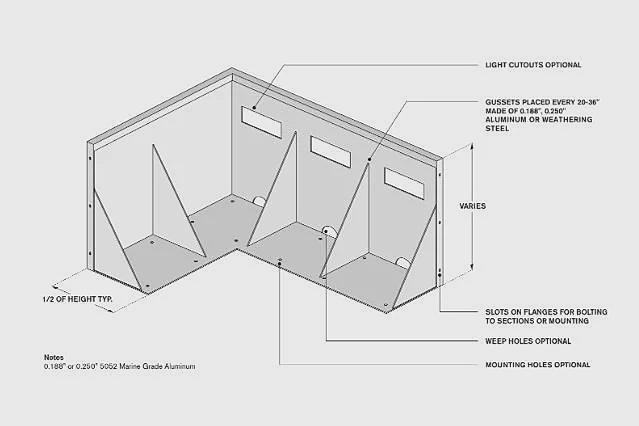
When bolting metal planter walls together, we find the following approaches work best:
Bending or welding flanges for bolting at the joints
Using gussets (placed every 20-36”) for bolting the sections together
For unanchored designs, we recommend using a broader base (usually at least half the height of the planter) for greater stability
To simplify installation, all PureModern modular retaining edging planters come with bolting hardware. You’ll also have options to include mounting holes, light cutouts, or weep holes.
3. Explore how others have used (and installed) modular retaining edging planters
Before purchasing modular retaining edging planters, it’s helpful to explore how others have installed and utilized them in rooftop projects. Studying existing projects provides valuable insights into best practices for installation and design. Want to see how modular planters can elevate your next project? Request a custom design consultation with our team today!
Planter edging walls can be anchored to a footing or concrete slab or placed directly on the substrate. Simply provide your design parameters and site requirements and we can manufacture a customized solution.
So you can imagine the available custom options, below are two examples with explanatory details below each one.
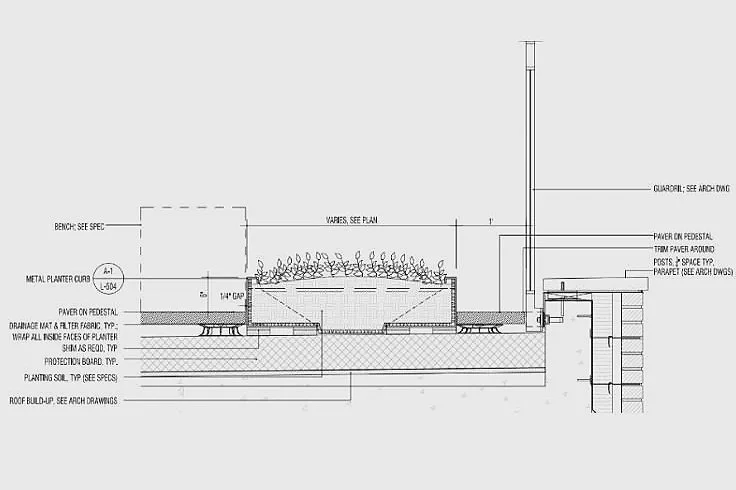
In the example above, you’re seeing a cross-section of a project where modular planters were seamlessly integrated on a second-floor terrace. Here are a few details about this project:
Rooftop pavers butt to the metal planter curb.
The pavers are on pedestals that sit atop a protection board (could also sit atop a layer of insulation).
The metal planter curb sits on shims atop the protection board, positioned next to the pavers for a clean, cohesive look.
The metal planter curb is lined with a drainage mat and some filter fabric to ensure proper water management before soil is added.
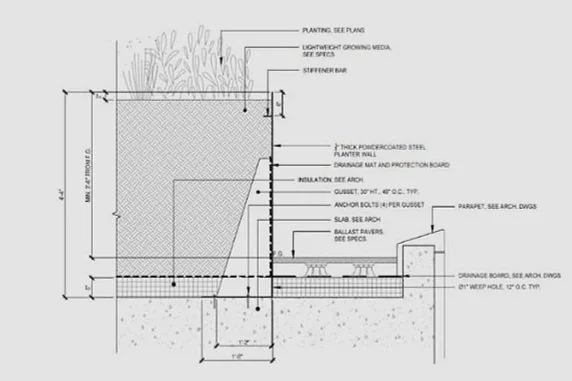
In the second example (directly above), you’re seeing a cross-section of a planter that was installed at a building’s parapet (the wall around the rooftop). Here are more details about this project:
The metal planter walls can be 3/16” thick.
The planter measures 4 feet 4 inches in height, with a 1-foot 6-inch base.
To ensure durability in rooftop conditions, the planter is reinforced with 30”-high gussets on a 1-foot 2-inch base.
To prevent bowing of the metal, a stiffener bar was added at the top of the planter.
The planter is securely anchored to the concrete slab using anchor bolts.
Ballast pavers butt against the planter wall to allow for maintenance access
The planter has insulation at the bottom and beneath the pedestals for thermal protection.
Inside the planter, a drainage mat and protection board help manage water flow.
Weep holes were cut into the metal wall to ensure proper drainage.
4. See how vast custom options really are
When selecting modular retaining edging planters, you aren’t limited to standard shapes.
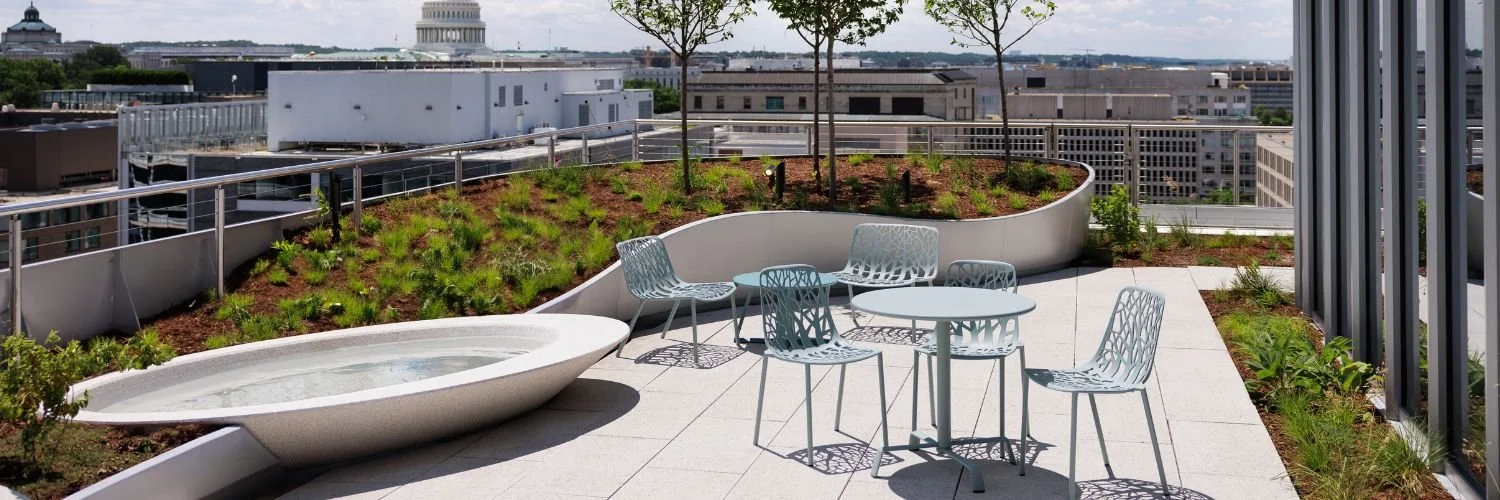
PureModern planter solutions on the green roof and terrace at Georgetown University’s new, state-of-the-art academic building and home to the McCourt School of Public Policy. To align with the project’s art installations, we manufactured these one-of-a-kind planters withedges that undulate horizontally and vertically to mimic earthen mounds and ocean swells.
Customization allows you to create a planter system in almost any shape you can imagine to fit your project’s unique needs:
Need to nestle a planter into the side of a fountain?
Interested in creating a planter shape that no design project has ever used before?
Want to incorporate lighting into your planter solution?
Need weep holes or mounting points?
Wondering about creating holes for an electrical conduit or a custom standard detail?
Concerned about maintaining your project’s LEED-Platinum certification?
A well-designed custom planter solution can seamlessly integrate any of these features.
If you have a vision for your design concept, we can create detailed drawings to bring it to life. We’ll help make your rooftop project truly one of a kind with custom solutions that enhance both functionality and aesthetics.
5. Dig into the details about customer service, lead times, guarantees, and pricing
When purchasing modular retaining edging planters, we understand that your ultimate goal is to look good in front of your clients. This means you need high-quality, visually stunning planters delivered on time and within budget.
How can you make sure this happens? To ensure a smooth experience, you need a solid understanding of how the following components work:
Expertise. With nearly two decades of experience, we manufacture commercial planters in a wide range of materials. Every component is engineered for your unique specs, and overseen by our founder, a civil engineer, to ensure seamless installation.
Customer service. At PureModern, we have worked with numerous clients to understand what’s important to them and placed our focus on making our customers feel heard, important, and well-served.
Lead times. Our lead times average just 4–7 weeks, while the industry standard can be 12 weeks or longer.
Guarantee. Does the manufacturer ensure your order meets exact specifications, is delivered on time, and receives immediate attention should any issues arise? At PureModern, our Done-Right Guarantee checks all those boxes.
Warranty. At PureModern, we offer a 10-year structural warranty that ensures the durability of the planter's structure and a 3-year powder coat warranty that covers the finish and protects against wear and tear.
Shipping. Our Four-Step Project Process ensures efficient production and on-time delivery. Plus, shipping is available across the U.S. and Canada.
Pricing. Some basic information about planter pricing:
Standard planters have set prices.
Fiberglass planters come in stocked sizes, while metal planters are made to order, which impacts lead times.
For custom modular designs, pricing depends on factors such as raw material quantity, material type and gauge, design complexity, and labor-intensive details like top lips, inlays, and cutouts for lights or drainage.
To optimize costs, consider simpler designs. For example:
Right angles are generally more affordable than curved edges.
Planter size, plus the amount of material and labor impact planter costs.
Inquire about wholesale, industry, and trade sales programs. As a member of PureModern's Wholesale, Industry, and Trade Sales Program, you can enjoy a dedicated trade sales representative, 20% to 40% discounts based on project size, and shipping across the U.S. and Canada.
Understanding these key details will help you manage costs and ensure a smooth ordering and installation process.
FAQs
What are the benefits of using modular retaining edging planters on a green roof?
Modular retaining edging planters offer flexibility in design, durability, and efficient use of space, making them ideal for green roofs.
How do I choose the right material for my planter walls?
Selecting materials like COR-TEN weathering steel or marine-grade aluminum ensures longevity and resistance to environmental factors.
What factors should I consider when customizing planter dimensions?
Consider the height, length, curve radius, and top lip design to ensure structural integrity and aesthetic appeal.
How are modular planter walls installed on rooftops?
Installation methods vary; they can be anchored to a footing or concrete slab or placed directly on the substrate, depending on design requirements.
Can modular planters be designed to fit unique rooftop layouts?
Yes, modular planters can be customized to accommodate various shapes and sizes, fitting seamlessly into unique rooftop designs. Check out this project we performed for Georgetown University. We manufactured one-of-a-kind planters in highly customized shapes to align with an art installation for this project.
What maintenance is required for metal planter walls?
High-quality materials minimize maintenance needs; however, regular inspections are essential to ensure longevity and optimal performance.
Learn More
For almost two decades, PureModern has been manufacturing custom planters tailored to our clients’ exact specifications, budget, and timeline. Ready to transform your rooftop with modular planter walls? Contact us today for a custom quote and let’s bring your vision to life!
